
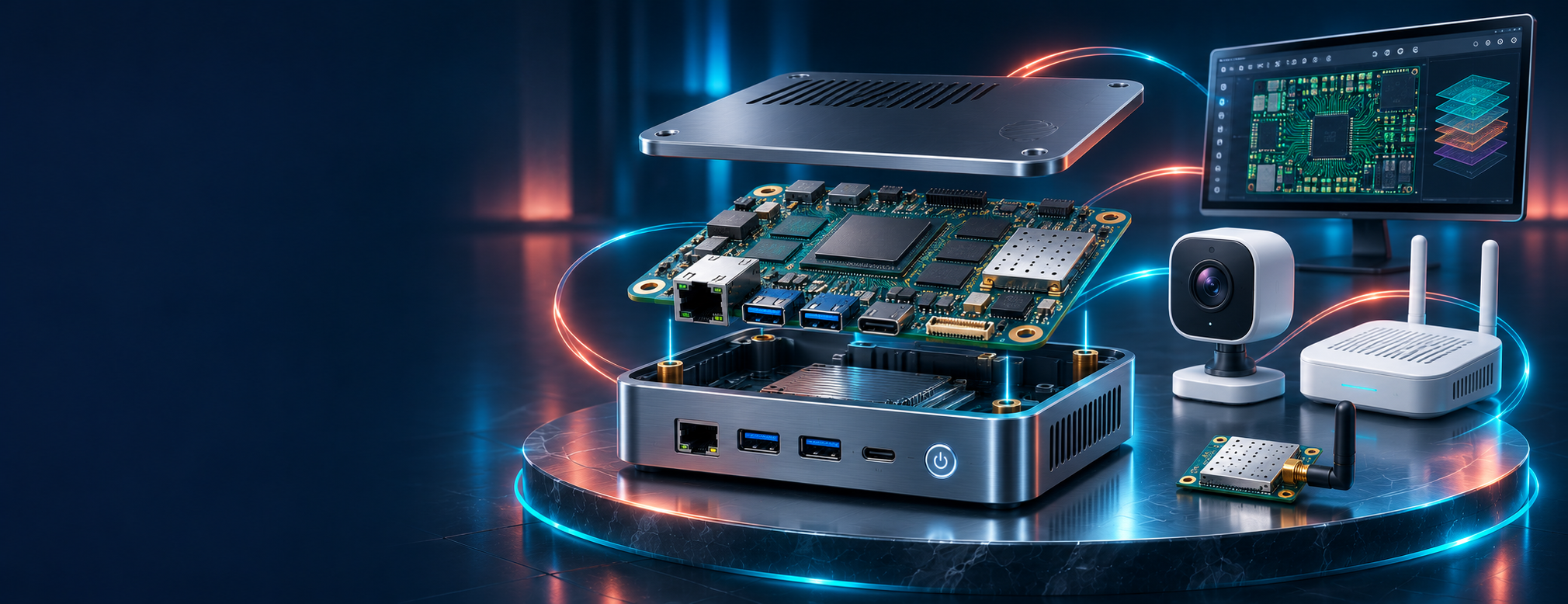




Product architecture
Break down functional, interface, power, and connectivity requirements; choose a platform direction suited to the device, data, and operating environment.
Connect functional requirements with schematics, PCB, and firmware. Define engineering interfaces so the product develops along a shared roadmap.
A device must be seen as a system: power, signals, connectivity, mechanics, firmware, and production testing methods. HTGSOFT coordinates engineering layers from the requirements stage to clarify dependencies and prepare subsequent development steps.
Break down functional, interface, power, and connectivity requirements; choose a platform direction suited to the device, data, and operating environment.
Design or review schematics, components, symbols, and footprints; maintain design information and checking rules across versions.
Organize stack-up, placement, and routing for digital, analog, mixed-signal, or RF designs; consider signal, power, and manufacturability constraints.
Incorporate fabrication, assembly, and testability requirements into design; review thermal behavior, signal integrity, and points needing verification.
Coordinate firmware, drivers, and interfaces so boards work with applications or connected platforms; support bring-up and fault isolation.
Prepare design data, configurations, tests, and quality requirements to coordinate fabrication, assembly, trials, and handover along the roadmap.
Four capability groups connect product architecture with handover data and NPI preparation.
Product specifications become functional blocks, power systems, and connections. Component selection and schematic organization are coordinated with firmware, mechanical, and testing requirements.
A shared technical basis for device development and verification.
Power, signal, stack-up, and fabrication constraints are clarified before or during layout. Teams track changes affecting placement, routing, and fabrication data.
Clearly see design conditions to verify before handover.
Verification plans connect expected functions with measurements, tools, and test conditions. Hardware, firmware, and related components coordinate bring-up and debugging to isolate discrepancies.
Technical issues have data for analysis and prioritization.
Production requirements are considered during design to prepare data, configurations, and testing methods. NPI and trial runs follow plans agreed with responsible parties.
The receiving team knows which data is needed and how to test.
The connections between people, data, and work within the solution.
A technical roadmap and verification responsibilities for each stage.
A clear improvement scope and tests to complete.
The parties share an information package for coordinating the next step.
Engineering steps connect to documents and checkpoints so each group knows what it receives and what needs confirmation.
Define functions, operating environments, interfaces, and design limits. Teams agree on hardware, firmware, mechanical, and testing scope.
Select platform approaches, build or review schematics and libraries, and lay out the PCB. Incorporate power, signal, and fabrication constraints into the design.
Review DFM/DFT and prepare bring-up and testing against selected criteria. Record results to revise the design or improve testing methods.
Gather design data and configuration, assembly, and testing requirements. Coordinate NPI and trial runs according to responsibilities agreed with relevant parties.
Need a roadmap from specifications to schematics, PCB, and embedded software, with coordinated engineering layers.
Need to review boards, component platforms, connections, or manufacturability when improving an existing device line.
Need fabrication, assembly, testing, and quality requirements incorporated into design completion and handover.
Scope is defined according to the maturity of the idea or existing design. Handover documents, revision rounds, mechanics, certifications, components, fabrication, and production need clarification in the proposal. Specialized chip requirements can begin with architecture consulting, specifications, and evaluation of RTL/FPGA options or system-level chip integration.
Requirements, interfaces & operating environments
Schematics, PCB, firmware & verification plans
DFM/NPI, handover data & chip scope
Define the right scope for your organization together.
Provided data, improvement goals, and technical limits can be assessed. Review, redesign, or platform-migration approaches depend on design usage rights, existing documentation, and project acceptance requirements.
Design, fabrication, assembly, mechanics, testing, and certification work must be defined separately in the proposal. Handover data and supplier-coordination responsibilities are agreed according to the product development roadmap.
PCBs connect components and functional blocks on a board; chip design concerns functions or architecture within an integrated circuit. HTGSOFT can receive chip-consulting requirements to define specifications, RTL/FPGA direction, verification plans, and integration with boards and firmware. Execution scope is finalized after technical assessment.

Share your software, collaboration, infrastructure, or hardware design needs. Together, define an implementation approach suited to your organization.